01
Radiation exposure
Energetic particles can upset or damage electronics and add to crew exposure. Beyond Earth’s protective environment, shielding and timely shelter decisions become central to mission planning.
LEO · CISLUNAR · LUNAR SURFACE
The space-environment intelligence network for orbital infrastructure, defense, and permanent operations on the Moon.
Discover our approach ↗Civil and military missions
SCROLL TO EXPLORE ↓01 / THE THREAT
A mission’s exposure changes along its route—from atmospheric drag in LEO to radiation in cislunar space and plasma interactions at the lunar surface.
Solar activity is only part of the picture. Local conditions, mission phase, and the vulnerability of each spacecraft or surface asset determine the operational consequence.
01
Energetic particles can upset or damage electronics and add to crew exposure. Beyond Earth’s protective environment, shielding and timely shelter decisions become central to mission planning.
02
Interactions with plasma and sunlight can create electrical potential differences. Discharges can disturb hardware; lunar light, shadow, and local plasma make surface conditions especially important.
03
Storm-driven drag changes orbit predictions in LEO. Communications and navigation can also be disrupted, affecting coordination between spacecraft, relay assets, and mission teams.
02 / OUR APPROACH
ANOR is developing a proliferated, distributed network of low-SWaP sensors to fill current observation gaps and expand observations across these environments.

Environmental context for orbital infrastructure and mission transitions.
Observations along transit routes and around lunar relay and orbital assets.
Local conditions for landers, rovers, crews, and sustained surface operations.
03 / THE VALUE OF SPACE WEATHER DATA
Environmental data supports immediate operating decisions and builds the historical record needed to investigate failures, assess financial risk, and improve predictive models.
Real-time observations help establish the environment a spacecraft is experiencing now. Combined with spacecraft telemetry, they give operators context to assess exposure, interpret anomalies, and decide whether to continue or adjust operations.
Forecasts help mission teams plan maneuvers, determine when to enter safe mode, and replan operations ahead of changing conditions. They inform when to reschedule sensitive activities and when to reassess a return to normal operations.
Compare anomaly and failure timelines with environmental observations at the spacecraft’s location. This helps engineers investigate whether space weather contributed to an event and distinguish environmental effects from other possible causes.
Records of environmental exposure give insurers evidence to inform mission risk assessment and underwriting. When an incident occurs, that history can also support loss investigation and claims analysis.
Accumulated observations provide data to train, calibrate, and validate space weather models. Comparing predictions with measured conditions helps identify forecast errors and improve models across orbital, cislunar, and lunar surface environments.
04 / PUBLIC MISSION PRIORITIES
Defense operations, operational forecasting, and lunar exploration need different outcomes from environmental data. ANOR’s development focus is an observation network whose data can be evaluated against those needs.
Military operators need timely environmental context to protect assets and sustain operations within a hybrid government-commercial architecture.
The mission need: connect environmental conditions to asset vulnerability, maneuver planning, protective modes, and operational continuity.
SSC’s hybrid strategy · May 2026 ↗Forecast centers need observations with usable coverage, low latency, and documented quality. Data must be evaluated before it enters operational forecasting systems.
The mission need: measurements with documented quality and uncertainty that can be tested for model impact and integrated into forecast workflows.
NOAA’s data evaluation priorities ↗Sustained lunar missions need better local measurements and predictive support for radiation and plasma effects on crews, spacecraft, and surface infrastructure.
The mission need: characterize conditions in cislunar space and at the lunar surface to support crew protection, hardware reliability, and activity planning.
NASA’s exploration data gaps · June 2026 ↗05 / BLOG
All articles ↗How a February 2022 geomagnetic storm contributed to the loss of 38 Starlink satellites, and what the event means for LEO mission risk and forecasting.
READ ARTICLE ↗Space weather lossesThe May 2024 Gannon storm changed satellite drag and challenged orbit predictions. Explore the operational exposure behind space weather losses in LEO.
READ ARTICLE ↗Space weather lossesA study linked the October 2024 geomagnetic storm to possible accelerated Starlink reentry. Understand the evidence, uncertainty, and lessons for loss attribution.
READ ARTICLE ↗Lunar radiationUnderstand galactic cosmic rays, solar energetic particles, and why radiation monitoring, forecasts, and shelter planning matter for lunar missions.
READ ARTICLE ↗Surface chargingWhat spacecraft surface charging is, how differential charging can lead to electrostatic discharge, and why local plasma context matters for failure analysis.
READ ARTICLE ↗06 / TEAM & ADVISORS
Experience across space,
science, and technology.
CEO
Repeat founder with 10+ years in deep tech and 2+ years focused on space weather. Former deep tech VC partner.
CFO
30+ years in technology finance. IPO and post-IPO leadership, capital raises, and M&A.

Technical Advisor
Former Tomorrow.io SVP of Space. Led space and radar programs. Ph.D., University of Michigan.

Space Weather Advisor
CU Boulder scientist and NASA SWORD Co-PI. Expertise in space weather modeling.

Government Contracting Advisor
Spaceport Company CEO and former U.S. diplomat. Expertise in government contracting.
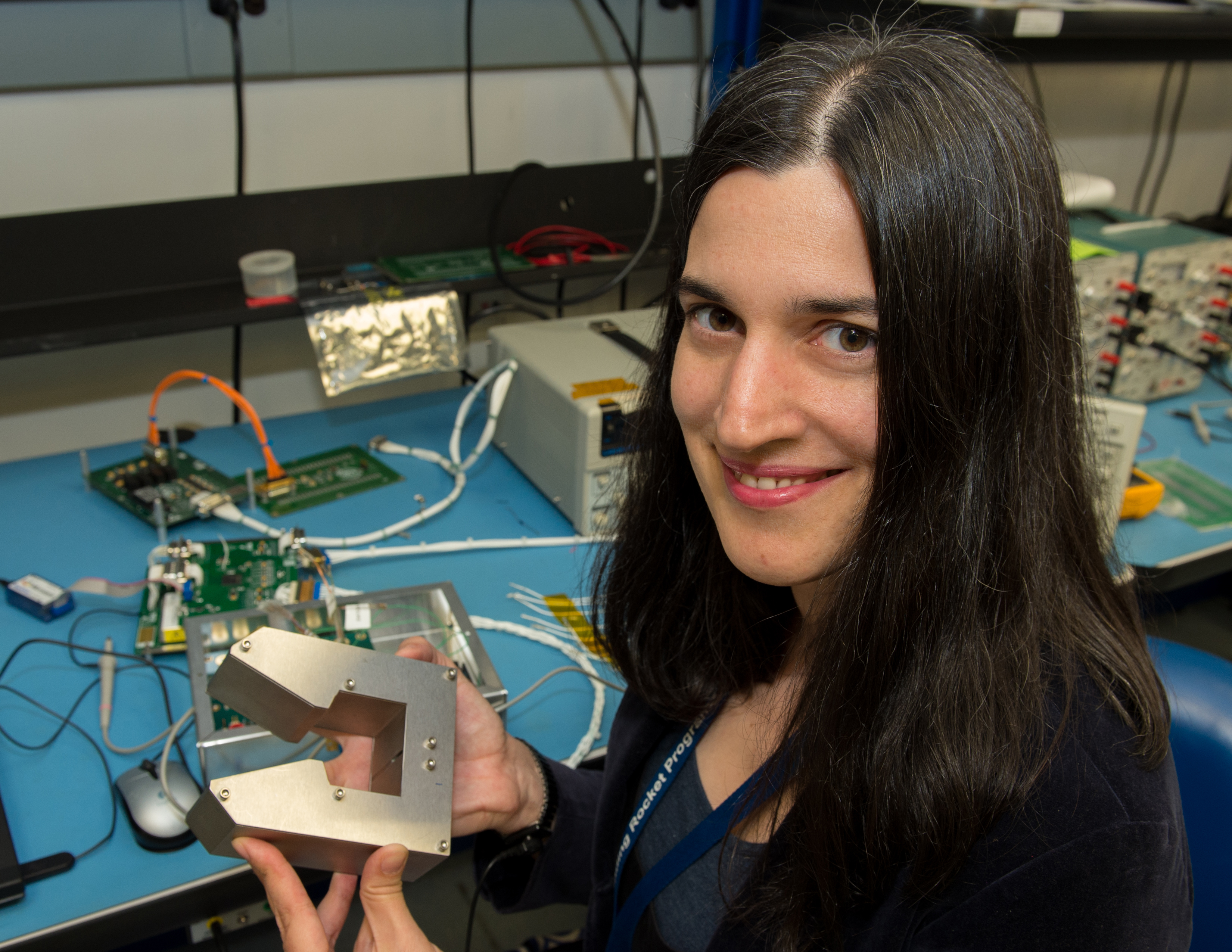
Research Astrophysicist
NASA Geospace Physics. Ionospheric physics and particle instrumentation.
Research Astrophysicist
NASA Goddard researcher. Fields and particles, and space instrumentation.

Research Astrophysicist
MMS / TRACERS scientist. Magnetic reconnection and plasma heating research.
Portraits: Marilia Samara — NASA / W. Hrybyk; Robert G. Michell — Bryan Whitten / The Sun Star.